 GuestLog in
 GuestLog in

Cocoron
Original game : Cocoron
Platform : Nintendo Entertainment System
Language : English
Released by : Akujin
Release date : 31 August 1999
Status : Fully Playable
Patch version : 1.0
Downloads : 5612
ROM Information
Cocoron (Japan).nes - NOINTROTranslation description
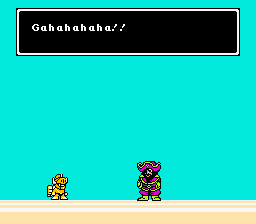
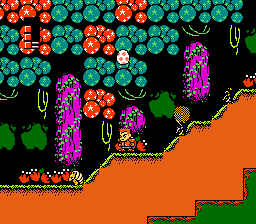
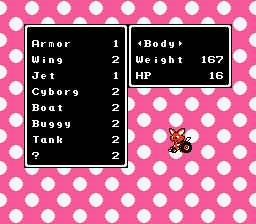
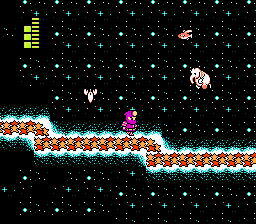
Akujin did this translation. It's very nice. And, um, everybody says stuff in English. Sweet!Screenshots
Contributions
| Contributor | Type of contribution | Description |
|---|---|---|
| Akujin | Hacking |
Reviews
| An authentic-feeling translation of a criminally little-known game. | The Beaky Buccaneer | 2021-07-16 | Version 1.0 |
Cocoron was the first post-Capcom work of Mega Man creator, and designer of the first two Mega Man games, Akira Kitamura. But in spite of this pedigree, and in spite of unused text existing in the game that suggests that a Western release was considered, the game never made it outside of Japan and remains largely unknown in the West even today - which is quite surprising for the game that's rumoured to be the reason that Capcom rushed Mega Man 3 to market! Dynamic Designs' English translation patch for the game corrects this oversight, and opens up Cocoron to a potentially wider audience today. It has that feeling of authenticity to the era that I'm always looking out for in fan-translations, and it's joy to play - it feels like you're discovering a lost treasure, and the translation could easily pass as unreleased official work if you didn't know any better. As for the game itself, it takes place in a dream realm, and after a whimsical, almost Studio Ghibli-esque, introductory flyover where the opening credits are displayed, you're introduced to a fuzzy blue character called Tapir who says that he can create any dream, and who just so happens to be one of gaming's earliest depictions of the dream-eating bagu creature from Japanese mythology (later depictions include the Pokemon Drowzee, and Bagoo from Klonoa: Empire of Dreams on the Game Boy Advance), or possibly the first of all of them. You're told that Rua, the princess of the dream kingdom, has been kidnapped, and that it's up to you to save her - and that you can take any form that you choose in order to do so. Any form? Well, in Cocoron, you don't acquire extra weapons like in the Mega Man games and others that follow their lead (which you might perhaps expect due to who created the game) - instead you get to build a succession of hero characters from a list of spare parts (Face, Body, and Arms - representing head, body, and weapon, respectively), each with different stats. Every part has multiple characterful different looks available, adding to the variety of heroes that you can create, and you get to give them a short name, too, which serves to increase your attachment to your creations (a small touch, but one that helps to make the game even more memorable). What, or rather who, you build affects how you navigate the levels and how you can tackle enemies, and also how easy or difficult that might be. With an authentic translation that genuinely feels like it could've been created at the time of the game's release, a catchy soundtrack partly created by Mega Man 2 composer Takashi Tateishi, lots of polish and cute details, and a thoroughly charming premise, Cocoron is well worth checking out and will be a new experience for many. Those who like Mega Man or the late NES title Little Samson (which Cocoron directly preceded), as well as those who enjoy dream-themed games like Kirby's Adventure, and Little Nemo: The Dream Master, will probably find a lot to like here, as will fans of platformers in general. I tested this game in the versions of RetroPie for both the Raspberry Pi 4 Model B and the Raspberry Pi Zero W, and it worked as it should with both. | |||